The who, the what, and the why, in one page. No deck required to start the conversation, just an honest read on where OVREN stands.
About a 3-minute readOVREN is built by Nick Rapoport and Michael Edward. It's built for the people who run a hospital in motion: the manager coordinating a surge, the charge nurse running bed flow, the ER and trauma teams working a live floor, and everyone else whose shift doesn't happen at a workstation. Same data, wherever you're standing.
Background in UX design and product management. Building OVREN full time.
Founder of ENSŌ DSGN. Twenty years in AI product design and experience strategy, nearly seven at Microsoft.
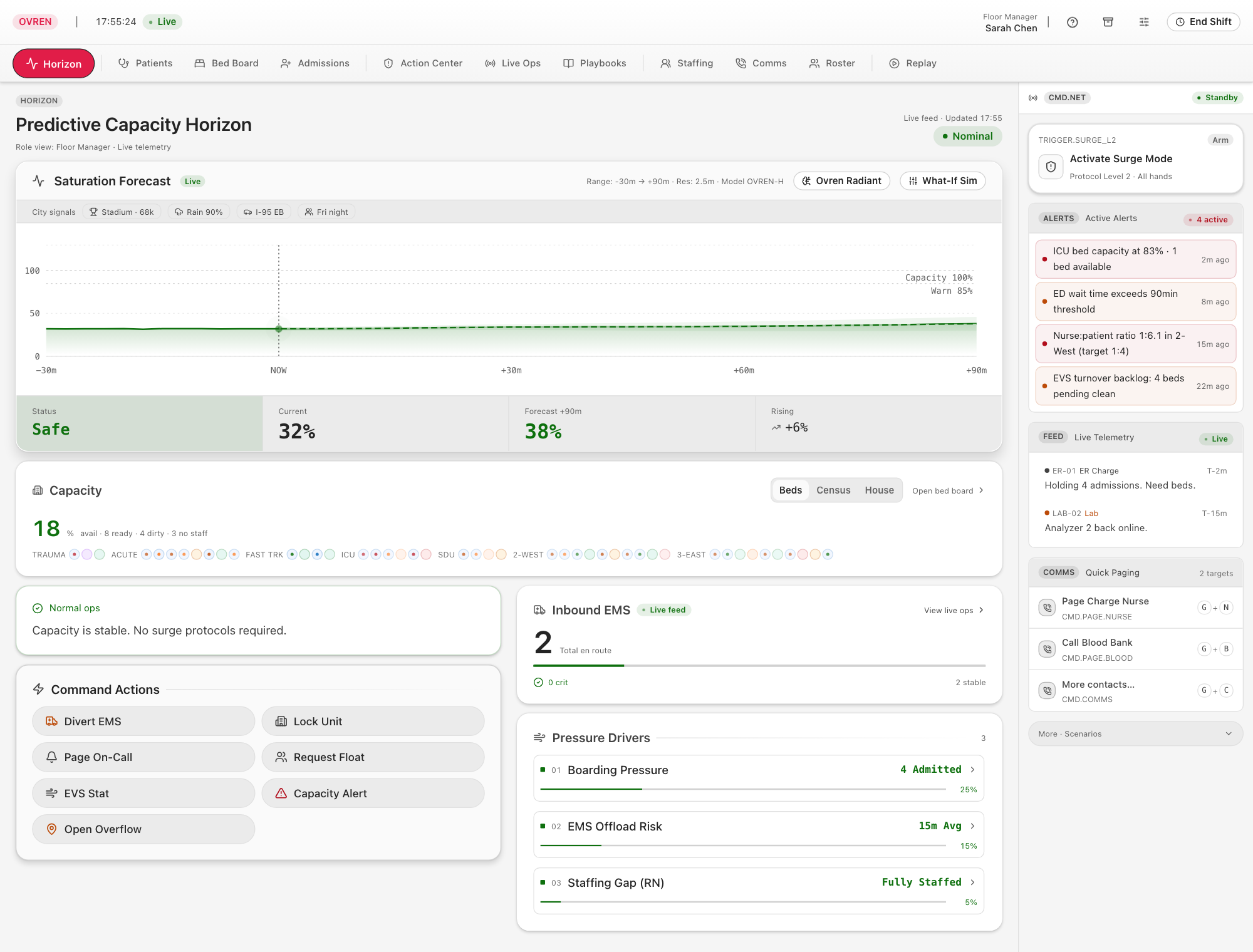
Hospital teams run inside a maze of disconnected systems: EHR, lab, pharmacy, paging, bed board, EVS, vitals monitor, each with its own ping. Critical signal gets lost in the noise, handoffs get interrupted, decisions get delayed. OVREN condenses that into one screen: situational awareness, AI-assisted coordination, and a mobile companion built for people who aren't sitting at a workstation.
Epic has spent thirty years owning the chart. In that time, it never shipped a tactical surface for the people who run a hospital in real time: the charge nurses, ops directors, and trauma teams who aren't sitting at a workstation. That's not a feature gap. A single-EHR vendor can't be the layer that sits above every system it doesn't own. Fusing signal across the EHR, bed management, staffing, and city-level feeds isn't something Epic ships as an update. It's a different company. That's the room OVREN is built for.
Hospital operations are under real, ongoing pressure: staffing shortages, patient boarding, and margin compression aren't a moment, they're the baseline. That pressure isn't going away, and the tools built for the people managing it in real time haven't caught up. That gap is the opportunity, and it's open now.
Hospitals don't buy fast, and they don't buy from a two-person team stretched across every function. Selling into a hospital takes months of relationship-building, security review, and pilot deployment before a single contract closes. Building software that meets that environment's bar takes real engineering time before it takes a single sales call. Right now, Nick and Michael are building the product, the design, and the pilot conversations themselves. Capital buys the thing time alone can't: a team that runs all of that in parallel instead of two founders doing it in sequence, while the window this thesis depends on is still open.
Ship the roadmap on a team's hours, not two founders'.
Get OVREN live inside a real hospital's operations, not just a demo.
The audits and infrastructure a hospital requires before it will sign.
The relationships and sales cycle hospital software actually requires.
Round size, terms, and timeline are a conversation, not a webpage claim. This page is the case for why that conversation is worth having; the specifics come next, directly from Nick and Michael.
If the case above makes sense to you, the next step is a conversation with Nick and Michael directly, not a form.